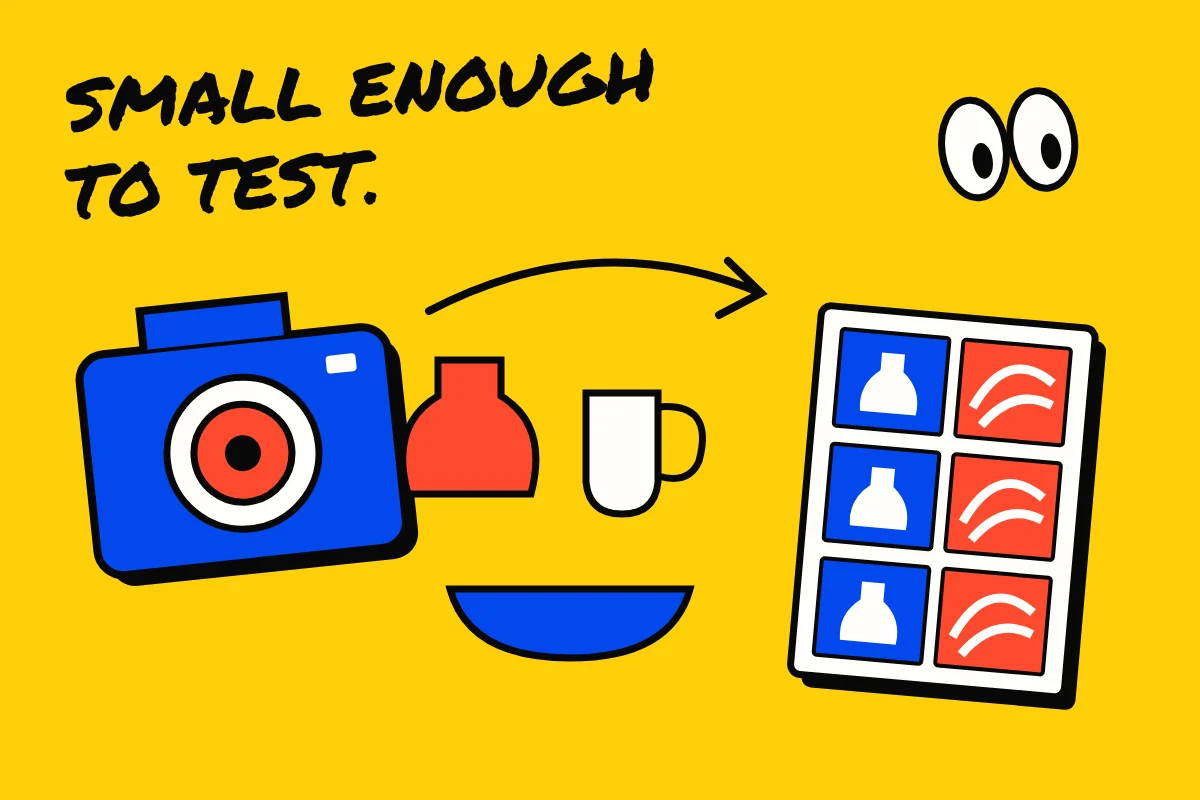
A website can explain an offer clearly and still leave the important question unanswered: does anyone need the offer? Before building a large site around a new business idea, define one small thing you could deliver, identify who might need it and decide what evidence would make you revise it.
Goodie’s 2022 resources page linked to the original Turn Your Passion Into a Business booklet (PDF, about 6.4 MB). The 12-page file is still available at its original host. This article is an independent exercise alongside that historical resource, not a reproduction of it.
What the booklet starts—and what you still have to find out
The booklet moves from combining interests to developing an idea, imagining its future, starting on a manageable scale and seeking help. Its useful starting point is personal fit: an activity you enjoy may suggest work you want to keep doing. That does not establish demand for a particular service.
Read its trend examples as a snapshot of 2022. They are prompts, not evidence that a named market remains attractive. Likewise, its suggested weekly time range is an illustration, not a tested workload for every business. The missing bridge is concrete: which person has which problem, and what can you actually deliver for them?
Work through one imaginary offer
Consider a hypothetical person who enjoys photography, careful arrangement and working with small objects. “I want a photography business” leaves too many decisions open. For this exercise, narrow the proposal to product photographs for independent ceramic makers preparing a small online collection.
A first version might cover three objects, with one front view and one detail view of each. That means six finished images. Delivery would include the agreed crops and filenames; video, styling props, collection of goods and uploading the shop would be outside this example’s scope. These are invented terms for a planning exercise, not a Goodie service or a recommendation about commercial pricing.
The narrowness makes the questions visible. Can the photographer represent glaze and shape accurately? Does the maker need those views, or do customers mostly ask about scale? Does arranging safe transport take more effort than the photography? Each answer can change the offer before a designer starts building pages around it.
Ask about an actual situation
The U.S. Small Business Administration’s market-research guidance distinguishes existing information from research conducted directly with potential customers. It identifies demand, alternatives and location as questions to investigate, and includes interviews among the available methods. Here, the useful application is a conversation about a recent task.
Instead of asking whether someone likes the imaginary photography idea, ask how they prepared the pictures for their last collection. What did they do themselves? Which image was hardest to get right? What happened when an object looked different on screen? Record the answer separately from your interpretation.
For example, “three people praised the idea” and “one maker described needing a consistent size reference in every image” are different observations. The second gives you a specific design problem to investigate. Neither establishes a general market. A conversation is a lead to test, not permission to publish an invented success story.
Keep the first test on one page
Copy these prompts into your own notes. The filled-in details continue the fictional example; replace them with your own evidence.
- Person and situation: an independent ceramic maker preparing a small collection for an existing shop.
- Deliverable: six agreed photographs of three objects, with a defined crop and delivery format.
- Assumption: a consistent set would solve a problem the maker currently encounters.
- Uncertainty: whether colour, scale, turnaround or something else matters most to that maker.
- Small test: with permission, prepare a sample for one object and ask the maker to use it in their actual workflow.
- Record: preparation, photography, editing and communication time; requested changes; and what the maker could or could not use.
- Decision: keep, narrow or revise the offer according to those observations.
Decide what would change your mind before running the test. If the maker mainly needs a demonstration video, a package of still images may be the wrong answer. If the sample is useful but requires more handling than expected, reconsider the scope. For instance, an offer that assumes the maker delivers and collects the objects needs to say so; silently absorbing transport changes the work being tested. An imperfect result can save you from designing an elaborate website for an offer you cannot yet explain.
Give the website a job it can actually do
Once the offer is specific enough, the page brief becomes simpler. Show the intended customer and situation, describe the actual deliverable, display an authorised sample, state the limits and provide a working enquiry route. Use a caption to distinguish a demonstration from paid client work. Do not add a testimonial or a result that the small test did not produce.
In the fictional example, a useful page would answer what six images include, what the maker supplies and how to discuss an object that falls outside the scope. A grand claim about transforming every online business would contribute less than those practical details.
Keep the offer note beside the design brief. When a heading, image or form field is proposed, ask which unanswered reader question it handles. The website then becomes a way to explain and investigate a defined offer, rather than a way to postpone defining it.
For the source history behind this exercise, read the guide to Goodie’s archived pages. If your next problem concerns navigation, images or loading, use the web-design resources guide to choose a focused technical check.